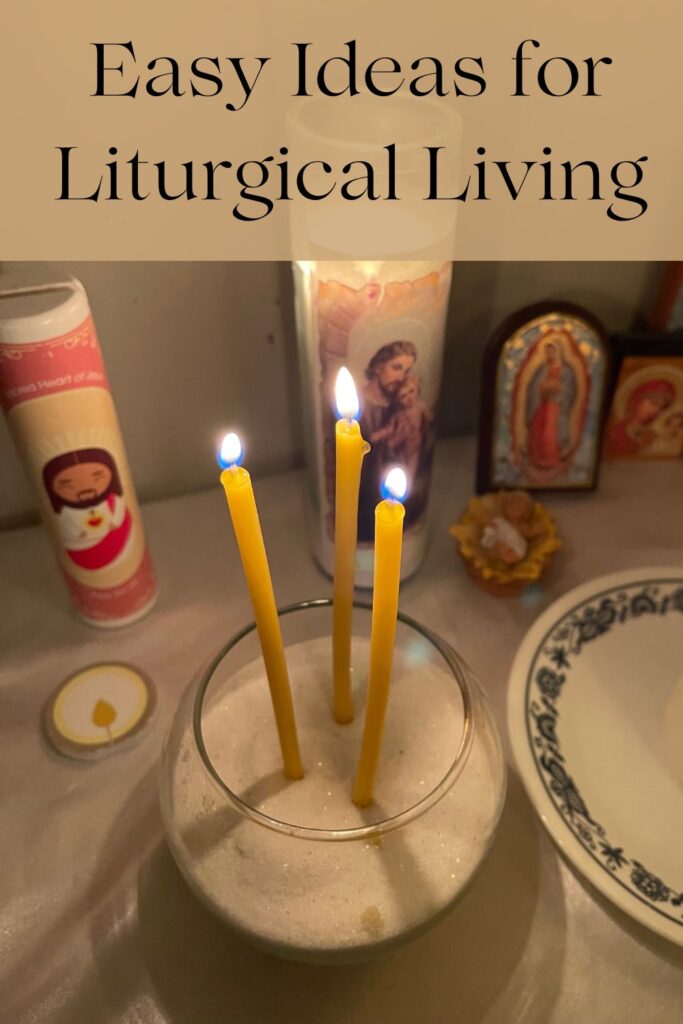

Is the concept of “liturgical living” overwhelming for you? In this post I want to help you learn that even if you have small children, a busy family, or are not a crafty mom like me – liturgical living is for all Catholics!

“Liturgical living” has become a bit of a buzzword in the Catholic-sphere online. If you’re a young Catholic mom, you’ve probably heard this term via social media. You’ve perhaps seen color-coordinated Instagram squares, well behaved children quietly at prayer or crafting, wooden toys arranged just so on wooden shelves, and elaborate or from-scratch meals.
These things are very beautiful in and they’re not wrong. But when our concept of “liturgical living” is only this kind of idealism, it will seem totally unrealistic. I admit that I am not a crafty mom. I also seem to have an inability to achieve color-coordination on Instagram and my three little boys certainly do not sit quietly at prayer – at least, rarely.
So let’s explore some easy ways to start liturgical living in our homes – ways that are beautiful and reverent, while also fun and realistic. One reason I started this blog is to help other Catholic mothers live out the Church year in their homes in a practical way.
What is Liturgical Living?
First, let’s define “liturgical living.” It’s the practice of incorporating the Church year, or Catholic liturgical calendar, into our domestic churches – that is, our homes! It can be put into practice using special prayers, foods, crafts, sacramentals, music, and colors. It can be as simple or as elaborate as you’re called to. The ages of your children will partially determine this! When you have really little ones like I do, things will be pretty simple. As they get older, they can have more responsibilities and even take charge of certain liturgical living practices themselves.
Now that we know what liturgical living is, let’s explore easy ways to start doing it!
Liturgical Living with Food
This is by far my favorite way to celebrate the Church year: with food! We have to eat anyway, so why not make special foods for the different feasts and fasts we observe? Your children probably love joining you in the kitchen, as mine do, and it’s more exciting for them to eat something that they’ve made with their own hands.
Here are some foods that we have made in the last few months to help us live liturgically:
- Soul Cakes for Halloween/All Souls Day
- Gingerbread Cookies using Nativity scene cookie cutters
- Santa Pancakes for St. Nicholas Day
- Shepherd’s Pie in the shape of a shepherd’s crook for St. Nicholas Day
- Chicken and Rice Risotto for St. Ambrose Day
- Taco Salad with all the fixings for Our Lady of Guadalupe feast day
- Lussekatter Buns for St. Lucy Day
- Vasilopita Cake for St. Basil the Great Day/New Year’s Day
- Kolyva for St. Theodore the Recruit Day
- Sourdough Soft Pretzels for Lent
- Sfinge Cream Puffs for St. Joseph Day
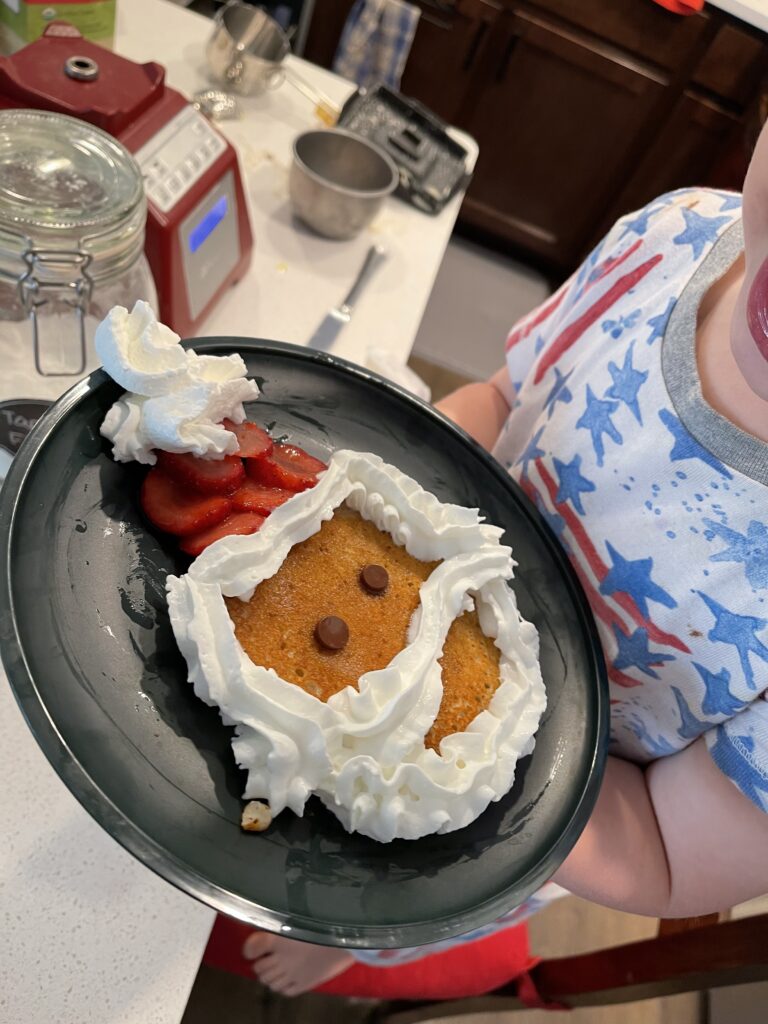


If special or intentional foods are the only thing you can handle for liturgical living in this season of your life, don’t feel guilty! Learning about the Church’s feast days while eating delicious food is a wonderful way to evangelize your children.
Liturgical Living with Crafts
Like I said above, I’m not a “crafty mom.” But since especially our oldest son is more eager to do projects, I’m trying to do more in this area. The most memorable thing we’ve done is decorate paper crowns for Epiphany. We had our own 3 little kings in the house this past Epiphany!

I also run an Etsy shop where I sell mainly sticker decals, and like to create new stickers for different feast days. The boys enjoyed getting to decorate their water bottles with my stickers!
Crafts don’t just have to be with paper and typical craft supplies; they can be done to make things that are actually useful. Below are some ideas:
- Make an Advent wreath with fresh or fake greenery
- Dip or roll beeswax candles for Advent and anytime you pray
- Coloring pages of the saints can be framed and used at your home altar/icon corner
- Dying or decorating hard-boiled eggs for Easter
- Making crosses out of palms for Palm Sunday – use to decorate your home altar
Liturgical Living with Music
Children love to sing and have a knack for easily learning things when put to song! Put together a playlist of your favorite hymns and religious music for your children to listen to throughout the year. For the major seasons like Advent, Christmas, Lent, and Eastertide, make specific playlists for those times.
And don’t just limit yourself to western Catholic music! Pope St. John Paul II called for us to breathe with “both lungs” of the Church, which means that as Roman Catholics we need to be familiar with our eastern Catholic brothers and sisters. Listen to Byzantine chant in addition to Gregorian chant. Learn about the 12 great feast days on the Byzantine calendar and find their “troparia” (stanzas of hymns) that they chant for those feasts. (See this link for the beautiful Paschal Troparion that is sung all of Paschaltide in the eastern churches!)
Liturgical Living with Colors
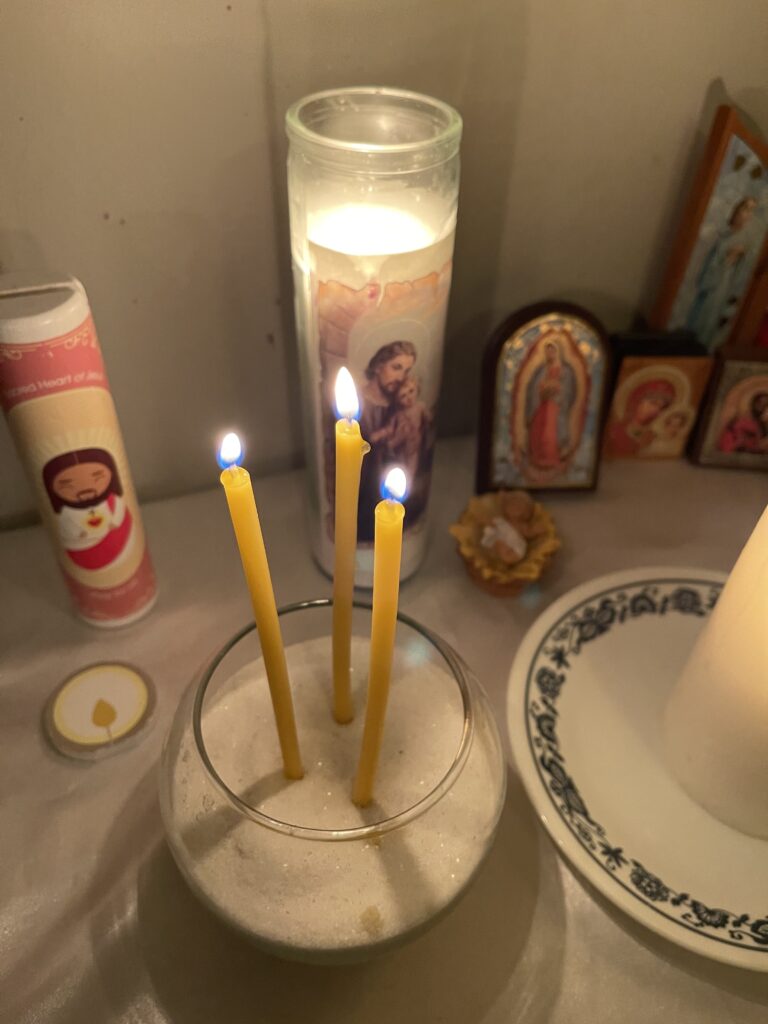
This is so easy! If you have a home altar (and if you don’t, stay tuned for a future post on how to make one!), this is the main place where liturgical colors will be reflected.
I created a home altar and icon corner last year, using a small table from Hobby Lobby. Then I purchased satin material to use as altar cloths. The colors I bought were:
- Purple for Advent and Lent
- White for Christmas and Easter
- Green for Ordinary Time
- Red for Pentecost and feasts of martyrs
- Blue for Marian feast days
I’m not a sewer, so I used Stitch Witch to hem the cloths. At the change of liturgical seasons or feasts, I simply change out the altar cloth. One piece of advice: try to get a material type that is stain resistant, because things like candle wax and dirty children’s hands WILL get on them!
Liturgical Living with Prayers, Books, and Sacramentals
This is also a very easy thing to do. If it’s a saint’s feast day you’re observing, search for a novena for that saint online. (Of course, this takes planning 9 days in advance!) Or simply find a prayer you can say the day of the saint’s feast.
There’s a plethora of saint books out there now: board books and picture books for the littles, and chapter books for the older ones. A saint’s feast day is the perfect excuse to get new books!
There are also certain sacramentals tied to different feast days. In the eastern churches especially, Epiphany (Theophany) is when water is specially blessed. So at Epiphany you could make sure to stock up on holy water from your parish. Don’t forget to also have white chalk blessed for the traditional Epiphany house blessing.
On February 2, candles are traditionally blessed for Candlemas. You’d then use these candles for prayer time throughout the year. You could pick out a new rosary for each member of the family for Our Lady of the Rosary feast day, or make rosaries that can be sent to Catholic missions.
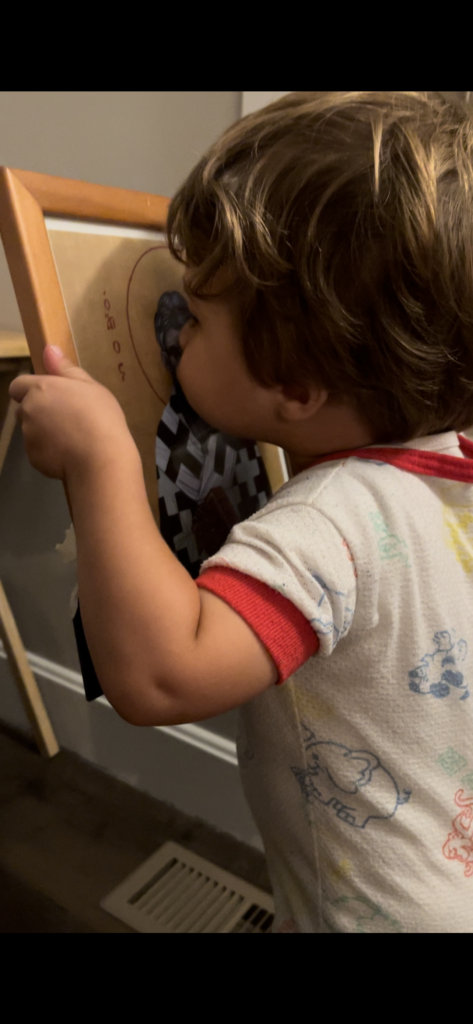
Another tradition from Byzantine Catholicism is featuring the icon of the feast. So at Christmas, have a Nativity icon front and center on your home altar. Do the same for Easter and other feasts of the Church like Pentecost, the Annunciation, the Assumption, and the Transfiguration. Also, kissing icons and pictures of the saints is a pious practice and children love it. Even our 1-year-old knows how to do it!
In Poland, celebrating one’s “name day” (the saint you’re named after) is a bigger deal than one’s birthday. Mark down your family’s name days on the calendar and plan to celebrate each saint’s day.
Forming Your Family Culture and Traditions
These are just some ideas to get you started! While there are so many ways to incorporate the Church calendar into our domestic churches, remember to keep the spirit behind the practices and not just focus on externals. Liturgical living is meant to draw our hearts and minds closer to Christ. Don’t stress yourself out if things don’t look perfect or if you feel like you’re not doing “enough.”
Liturgical living greatly contributes to the “warmth” of a home. It helps make living the Church year a core memory of your children. By actually living out our faith in the domestic church, rather than just having head knowledge about it, we form our family culture and traditions. One day with God’s grace, your children will pass on these same traditions to their own families.
Do you have any liturgical living traditions that your family already practices and that your children love? Did I miss anything? Share in the comments!